
TL;DR
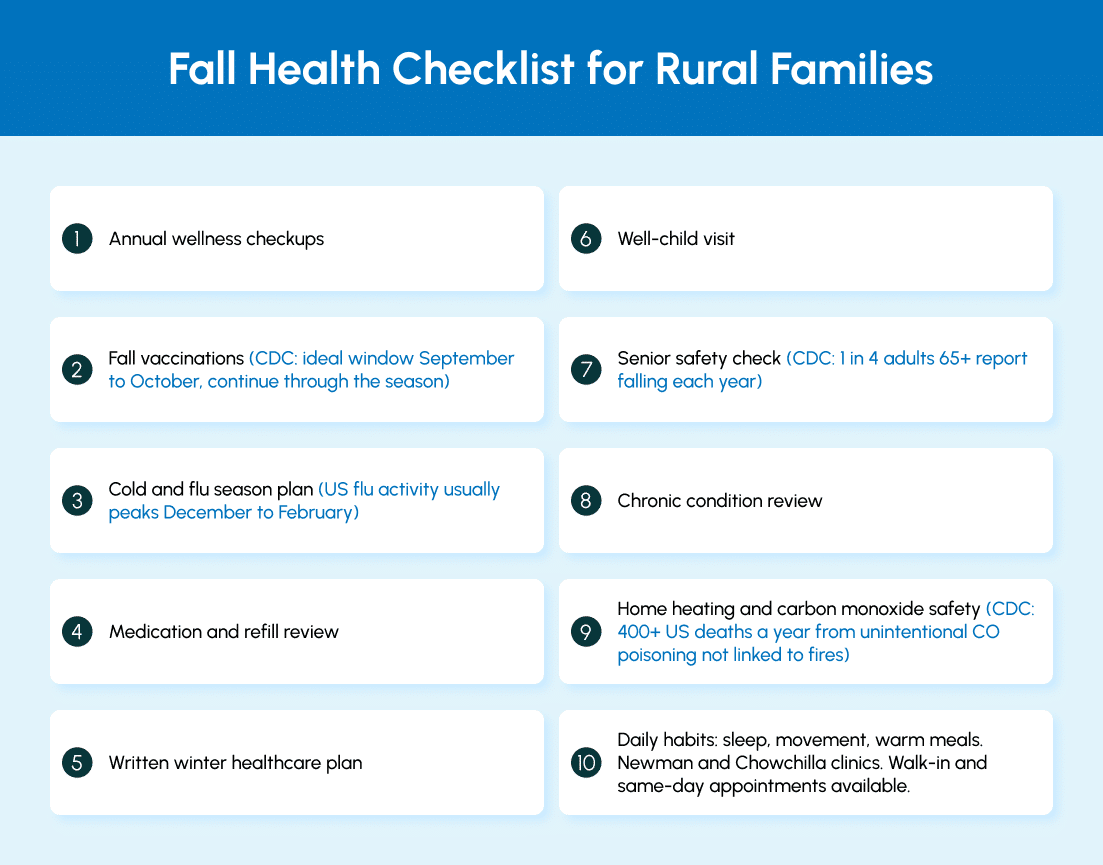
A fall health checklist covers ten things: wellness visits, fall vaccines, a cold-season plan, medication review, a winter care plan, children’s visits, senior safety, chronic condition check-ins, home heating safety, and daily habits.
CDC points to September and October as the ideal flu vaccine window, and advises continuing vaccination through the season while flu viruses circulate.
US flu activity usually peaks between December and February, so a November vaccine still lands ahead of the heaviest weeks.
Fall health tips to stay healthy.
A Fall Health Checklist for Rural Central Valley Families
November in the Central Valley is one of the better months of the year for a family health reset. The weather is still workable, the holidays have not taken over the calendar yet, and clinic schedules are easier to get into than they will be in January.
A fall health checklist that holds up through winter covers ten things: annual wellness visits, fall vaccines, a cold-season plan, a medication and refill review, a winter care plan, children’s visits, senior safety, chronic condition check-ins, home heating safety, and a few daily habits. That is the whole list of fall health tips. Read ahead to find out how we work through it with families at our Newman and Chowchilla clinics.
We are a community primary care practice; therefore, this version of these fall health tips reflects the hurdles rural families here face: distance, work schedules during harvest, and specialists who may be an hour away.
Talk to us about what’s best for you and your family.
1. Schedule Your Family’s Annual Wellness Checkups
A wellness visit anchors the whole fall health list because it’s where you can sort out the other nine items in one sitting. Most healthy adults are due for an annual checkup exam by this time of the year. Children and people managing a chronic condition usually follow a schedule set by their provider.
Booking in November is advisable, as it means the visit occurs before the respiratory season peaks. It also gives lab work, referrals, or imaging orders time to move before the end of the year.
What a family medicine services visit usually covers:
- Blood pressure, weight, and a review of what has changed since last year
- Screenings that are due based on age and history
- Vaccines that can be given the same day
- A look at every prescription and supplement you are taking
- Time to ask the questions you have been having
2. Get Recommended Fall Vaccinations
Fall vaccine benefits are definitely worth it, and November is a reasonable time to get them. CDC flu vaccine guidance points to September and October as the ideal window for most people and recommends continuing vaccination throughout the season while flu viruses circulate.
The question we hear most in early November is whether it is too late to get vaccinated. It is not. Flu activity in the United States peaks between December and February in most seasons, so a November shot still lands ahead of the heaviest weeks.
Vaccines to ask your provider about this fall:
- Seasonal flu vaccine, recommended for most people 6 months and older. Flu shot benefits are numerous and vital to everyone.
- The current COVID-19 vaccine, per COVID-19 guidance
- RSV and flu vaccine for adults 75 and older, and for adults 50 to 74 with certain conditions, as per RSV guidance
- Catch-up doses for children who are behind on the routine schedule
Some children between 6 months and 8 years old need two flu doses, four weeks apart, in their first season. If that applies to your child, starting now matters more than it does for the rest of the family.
3. Prepare for Cold and Flu Season
Preparing for cold and flu season is usually the top priority on a back-to-school health checklist. It mostly involves deciding in advance what your household will do when a member wakes up sick. That decision is much harder to make at 6 a.m. on a Tuesday with a child who has a fever.
A few fall health tips that should be included in the flu season plan:
- Who stays home with a sick child
- Where you go for same-day care, and what time they open
- A thermometer and a small supply of over-the-counter medication your family normally uses
- A plan for keeping a sick person’s dishes, towels, and sleeping space separate where possible
Regular handwashing and staying home when sick are still the two habits, among other fall health tips, that do the most and must not be taken lightly.
4. Review Medications and Prescriptions
Families often skip this fall health tip, and in our experience, it causes more January phone calls than anything else on the list.
We’ve seen a pattern: supply quietly ran out during the second week of December, when the office was closed for a holiday, and the weather was bad. As a result, we couldn’t review prescriptions and medications.
Bring to your visit:
- Every prescription bottle, including ones from a specialist
- Over-the-counter medicines and supplements you take regularly
- Inhalers, glucose meters, and testing supplies, so expiration dates get checked
- A note of anything you stopped taking and the reason you did so
5. Create a Winter Healthcare Plan
A winter healthcare plan is a one-page document that answers where your family goes for care, how you get there, and whom to call. Writing it down clearly eliminates a lot of hassle when you need it most. In our professional opinion, this is a crucial fall health tip.
Put on the page:
- Clinic addresses, phone numbers, and hours, including which days each location is closed
- Your pharmacy’s holiday hours
- Current insurance or coverage details
- A short list of each family member’s conditions and medications
6. Check on Children’s Health Before Winter
Children need a well-child visit on their own schedule, separate from whatever brought them in last. These visits check growth, development, hearing, vision, and vaccine status.
We often notice that many families come in for a sports physical in August, and we don’t see that child again until February. The August form and a well-child visit cover different ground.
Before winter, it helps to confirm:
- Routine immunizations are up to date for your child’s age
- Asthma or allergy plans are current, including school paperwork
- Anyone who needs glasses has had a recent vision check
- Your child’s school has the right emergency contacts
If a child has coughed more, wheezed more, or missed school more than usual this fall, mention it at the visit.
7. Give Extra Attention to Senior Family Members
For older adults, we most often talk about falls, heating, and getting to appointments. CDC reports that one in four adults 65 and older fall each year, and fewer than half tell a doctor.
Practical fall health tips to go through with a parent or grandparent to avoid falls:
- Lighting on stairs, hallways, and the back step
- Loose rugs, cords, and anything stored on the floor of a walkway
- Grab bars in the bathroom, which is where we hear about most of these falls
- Whether a medication is causing dizziness, which is a conversation for their provider
- A warm plan for cold nights that does not involve a space heater near bedding
Ask directly whether they have fallen in the past year. People tend not to volunteer it, partly because they worry about what the answer will lead to.
Book an Appointment for a parent or grandparent, and we will go through this list with them. If getting here is the hard part, tell us when you call, and we will work with you on timing.
8. Review Chronic Conditions Before the Weather Changes
Diabetes, high blood pressure, COPD, and asthma often need closer attention in winter because routines, diets, and activity levels change at the same time the air does. A key fall health tip is to stay on top of these with our chronic care management services.
A fall chronic care visit usually covers:
- Whether current readings match the goals you and your provider set
- Lab work that is due
- Supply counts for strips, inhalers, and monitors
- An action plan in writing for days when symptoms get worse
Winter inversions trap particulate pollution on the Valley floor, which is why the San Joaquin Valley Air Pollution Control District runs a residential wood smoke program through the colder months. If someone in your house has asthma or COPD, checking the daily burn status is a reasonable winter habit alongside the medical ones.
9. Prepare Your Home for Winter Health and Safety
Home safety belongs on a fall health checklist because heating season brings its own risks. CDC’s carbon monoxide basics page reports that more than 400 people in the US die each year from unintentional carbon monoxide poisoning not linked to fires. That number includes all sources, not just heating, though risk concentrates during the heating season.
Before the first cold week:
- Install or test a carbon monoxide detector near every sleeping area
- Have heating appliances serviced by a qualified technician
- Keep generators and camp stoves outside, well away from windows and doors
- Keep space heaters clear of bedding, curtains, and furniture
- Check that smoke alarms work on every floor
- Never use a stove or oven to heat a room
10. Build Healthy Habits for the Fall and Winter
The habits that carry a family through winter are ordinary ones: sleep, movement, food, and some daylight. None of these seasonal health tips are new, and that is the point.
Small things that hold up through January:
- A consistent bedtime, including on weekends
- Movement indoors on days when air quality or cold keeps everyone in
- Warm meals with protein and vegetables, planned for the busy nights
- Getting outside when the air is clear, even briefly
- Checking in on anyone in the family who is alone more in winter
Mental health is part of this. Shorter days and less contact with people affect the mood of many of our patients, and it is a reasonable topic to bring up at a visit.
When Should You Contact a Healthcare Provider?
Contact a provider if new symptoms develop, existing symptoms worsen, or symptoms do not improve as expected. Simple as that.
Reasons to call rather than wait:
- Trouble breathing, chest pain, confusion, or a severe headache, which need urgent attention
- A fever in an infant under 3 months
- Symptoms that improve and then get worse again
- A chronic condition reading that is outside the range your provider gave you
- Running out of a medication you take daily
When you are unsure, call. We would rather answer a question that turns out to be nothing than see someone a week later than we should have.
How Rural Families Can Stay Connected to Healthcare
Staying connected to care in a rural community means removing practical obstacles: distance, hours, cost, and work schedules. Each of those has a workaround.
- Clinics at two convenient locations: in Newman at 1349 Main St. and in Chowchilla at 1020 Ventura Ave
- Saturday hours in Chowchilla, which helps households working weekdays through harvest
Harvest schedules shape this more than people outside farm communities expect. Families here work long days through October, which is part of why a Saturday slot fills faster than a midweek one. The Chowchilla clinic is open on Saturdays and closed on Thursdays, which surprises people who assume the closed day is due to staffing rather than demand.
Conclusion
For most families, the highest-value pair is the wellness visit and the vaccines, because both get harder to schedule as December fills in. Pick your slots as soon as possible.
More seasonal guidance is on the Rural Health Network blog. Feel free to check it out.